
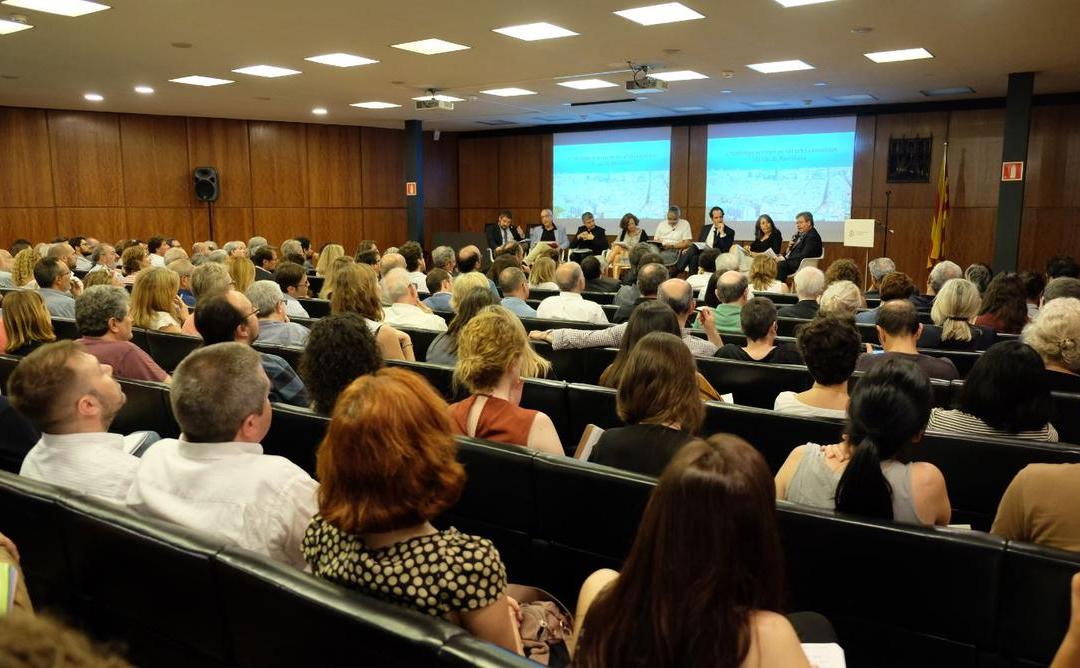
© Col·legi d'Arquitectes de Catalunya (COAC)
Big attendance numbers at COAC’s debate on protected housing
Àmbit:
Suport professional - Pràctica professional
Printer, email and PDF versions:


Publicat:
29 juny 2018
Addtoany:
On 28 June, the Architects’ Association hosted a debate entitled 'Protected housing on consolidated urban land: the case of Barcelona', moderated by Sebastià Jornet, the president of the Urban Planning Architects’ Association of Catalonia (AAUC). Participants included lawyers Josep M. Aguirre, professor at the University of Girona; Domènec Sibina, professor at the University of Barcelona; Javier Buron, in charge of Housing at Barcelona City Council; Dolors Clavell, from Clavell Consulting SL; Ramon García-Bragado, from Miliners Advocats i Assessors Tributaris; Pablo Molina, from J&A Garrigues; and Gemma Segura, from Pareja & Associats, Advocats.
Dolors Clavell noted that 'in the future it will be necessary to find the mechanisms for access to housing' and that these should be implemented structurally to avoid 'welfare measures, which are not appropriate in a twenty-first century housing policy'. According to Clavell, with the combination of the Spanish land law and the Catalan urban development and housing law, we should be able to generate protected housing reserves and adjust land classification.
ProfessorJosep Maria Aguirre highlighted three key weaknesses which he feels this Amendment of the Plan contains: the first is the issue of legality that may exist over the owner’s responsibilities, as the Spanish law does not mention affordable housing; the second is the loss of profitability that this reserve could cause to owners; and the third is asset liability. Meanwhile, professor Domènec Sibina suggested the need to reconsider an urban plan that was designed 45 years ago.
Lawyer Ramon García-Bragado proposed that the question we need to be asking 'is not whether this measure is legal or not, but whether the law is positive or negative for Barcelona'. The reasons behind his rejection are firstly that 'the law has been enacted without prior debate', and secondly, the violation of the principle of transparency, given that 'the procedure has been hidden'.
The head of Housing at Barcelona City Council, Javier Buron, asserted that this measure 'tackles the situation realistically' and maintained that the proposal already takes into account the situation of a pressurised market due to the lack of land, and that the transitional regime will provide the market with sufficient legal certainty. Buron gave the example of the city of Vitoria, where policies to promote affordable housing have been extremely successful.
Numerous institutional representatives and public administration officers attended the debate, including Janet Sanz, Josep M. Montaner, Ton Salvadó and Aurora López, from Barcelona City Council; Amadeu Iglesias, from IMPSOL; and Josep Bohigas, from Barcelona Regional. It was also attended by councillors Xavier Trias, from PDeCAT; Koldo Blanco, from Ciutadans; Jordi Coronas and Montserrat Benedí, from ERC; Daniel Mòdol, from PSC; as well as Carme Trilla, president of the Habitat3 Foundation; Elena Massó and Marc Torrent, from APCE; and Ramon Sanabria, from AxA, among others.
You can watch the video of the session here:
Dolors Clavell noted that 'in the future it will be necessary to find the mechanisms for access to housing' and that these should be implemented structurally to avoid 'welfare measures, which are not appropriate in a twenty-first century housing policy'. According to Clavell, with the combination of the Spanish land law and the Catalan urban development and housing law, we should be able to generate protected housing reserves and adjust land classification.
ProfessorJosep Maria Aguirre highlighted three key weaknesses which he feels this Amendment of the Plan contains: the first is the issue of legality that may exist over the owner’s responsibilities, as the Spanish law does not mention affordable housing; the second is the loss of profitability that this reserve could cause to owners; and the third is asset liability. Meanwhile, professor Domènec Sibina suggested the need to reconsider an urban plan that was designed 45 years ago.
Lawyer Ramon García-Bragado proposed that the question we need to be asking 'is not whether this measure is legal or not, but whether the law is positive or negative for Barcelona'. The reasons behind his rejection are firstly that 'the law has been enacted without prior debate', and secondly, the violation of the principle of transparency, given that 'the procedure has been hidden'.
The head of Housing at Barcelona City Council, Javier Buron, asserted that this measure 'tackles the situation realistically' and maintained that the proposal already takes into account the situation of a pressurised market due to the lack of land, and that the transitional regime will provide the market with sufficient legal certainty. Buron gave the example of the city of Vitoria, where policies to promote affordable housing have been extremely successful.
Numerous institutional representatives and public administration officers attended the debate, including Janet Sanz, Josep M. Montaner, Ton Salvadó and Aurora López, from Barcelona City Council; Amadeu Iglesias, from IMPSOL; and Josep Bohigas, from Barcelona Regional. It was also attended by councillors Xavier Trias, from PDeCAT; Koldo Blanco, from Ciutadans; Jordi Coronas and Montserrat Benedí, from ERC; Daniel Mòdol, from PSC; as well as Carme Trilla, president of the Habitat3 Foundation; Elena Massó and Marc Torrent, from APCE; and Ramon Sanabria, from AxA, among others.
You can watch the video of the session here: